Our Book of the Month for November, part of Books Unchained — our monthly series exploring the remarkable volumes preserved in Wells Cathedral’s historic Chained Library.
Visit the Blog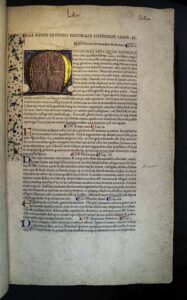
Wells Cathedral © David Sumner
Naturalis Historiae
Pliny the Elder
Venice, 1472
Pliny the Elder was born in northern Italy in 23 CE. A member of the Roman Equestrian class, he served both in the army and in public administration. He was renowned for his tireless curiosity and dedication to learning. Pliny took notes on everything he encountered and arranged to be read to constantly—during meals, while travelling, and even in the bath—so that no moment was wasted.
Naturalis Historiae (Natural History), is a vast encyclopaedia describing the world as it was understood in the 1st century CE. It covers an extraordinary range of subjects, including plants, medicine, agriculture, astronomy, minerals, and geography. A modern English translation is available in the Cathedral Reading Room, offering fascinating insight into the advanced knowledge of the Roman world.
Pliny died in 79 CE while investigating the eruption of Mount Vesuvius, which destroyed Pompeii and Herculaneum. He ventured too close to the volcano and was overcome by toxic fumes, dying of asphyxiation. Although his death is traditionally dated August as the agreed date of the eruption, some archaeological evidence has led some scholars to favour an autumn date in October or November.
Wells Cathedral © David Sumner
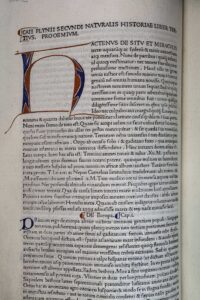
This copy of Naturalis Historiae at Wells Cathedral was printed in Venice in 1472, four years before the printing press arrived in England in 1476. It is a fine and beautiful example of early Renaissance printing.
The printer, Nicholas Jenson (1420–1480), was a Frenchman who learned the art of printing in Germany before settling in Venice. In 1470, he developed his distinctive Roman typeface, inspired by the elegant handwriting of humanist manuscripts. His design became an important influence on later typefaces and it is considered to be the forerunner of the Times New Roman font.
The book was printed with space left for decorative capitals to be added by hand, using red and blue inks as well as some illuminated capitals. This combination of early printing technology and traditional hand decoration helped to preserve the appearance and character of beautifully illuminated manuscripts.
Jenson’s 1472 edition of Naturalis Historiae is widely regarded as one of the greatest achievements of Renaissance printing. The designer and craftsman William Morris later admired it so greatly that he based the type of his own Kelmscott Press on Jenson’s design, seeking to recreate the beauty of the earliest printed books. Pliny is also often referenced in other titles held within Wells Cathedral Library such at William Turner’s New Herbal (1568).
Remarkably, this is the only book from Wells Cathedral Library’s pre-Reformation collection that remains in the library, despite disappearing for over one hundred years. Following the Dissolution of the Monasteries, the original library collection disappeared, and what happened to all the books remains a mystery. Although Wells Cathedral was never a monastic institution and continued as a secular cathedral after the Reformation, its library was nevertheless dispersed.
This volume was eventually rediscovered in 1682 by Dean Ralph Bathurst in a second-hand bookshop in Oxford. Recognising the Latin inscription Ex Libris Wellensis – meaning ‘From the Library of Wells’ – he purchased it with his own money and brought it back to the Cathedral. Having once been lost to the collection, it remains here today as a remarkable survivor of the Cathedral’s earlier library.