Our Book of the Month for September, part of Books Unchained — our monthly series exploring the remarkable volumes preserved in Wells Cathedral’s historic Chained Library.
Visit the Blog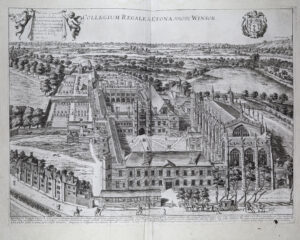
Oxonia Illustrata and Cantabrigia Illustrata
David Loggan
Oxford, 1675 and Cambridge, 1690
Wells Cathedral Library holds a volume containing both of Loggan’s great works, Oxonia Illustrata and Cantabrigia Illustrata, bound together as a single volume.
David Loggan (c.1634/35–1692) was a Polish-born artist, engraver and draughtsman who settled in England in the 1650s. He became particularly well known for his highly detailed views of Oxford and Cambridge. His engravings show buildings, gardens, streets and courtyards as they appeared before many later changes and developments.
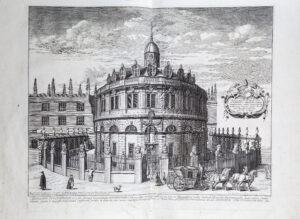
Published in 1675, Oxonia Illustrata contains 40 engraved plates showing Oxford’s colleges, university buildings and the city, as well as a plan and a representation of academic dress. These detailed bird’s-eye views allow us to see not only the grand buildings of the university, but also their surrounding gardens, courtyards and streets. The work was produced to accompany Anthony à Wood’s History and Antiquities of the University of Oxford, bringing together written and visual accounts of Oxford.
A similar project followed at Cambridge. Cantabrigia Illustrata was published in 1690 and contains detailed views of the colleges and principal buildings of Cambridge, together with plans and views of the city. Like the Oxford engravings, these images provide a fascinating picture of the university and its buildings at the end of the seventeenth century.
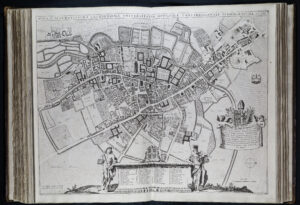
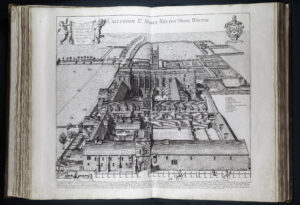
Photography by David Sumner.
The accuracy and attention to detail of these engravings make them especially useful today. Their careful depiction of buildings, gardens and surrounding spaces allows historians and researchers to trace how Oxford and Cambridge have changed over more than three centuries. At the same time, they offer a fascinating glimpse into the appearance and surroundings of university life in the seventeenth century.
There was also a connection between Loggan and Wells. In 1677, following the publication of Oxonia Illustrata, he placed an advertisement in the London Gazette concerning a lost drawing of Wells Cathedral. This suggests that Wells was among the historic buildings that attracted his interest, placing his work within a wider seventeenth-century interest in recording important architecture through drawings and engravings.
The volume in Wells Cathedral Library is therefore more than a beautiful example of seventeenth-century printing and engraving. It preserves a detailed visual record of two of England’s historic universities and provides an intriguing connection between Loggan’s work and Wells itself.