Our Book of the Month for July, part of Books Unchained — our monthly series exploring the remarkable volumes preserved in Wells Cathedral’s historic Chained Library.
Visit the Blog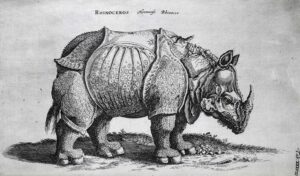
Historia Naturalis
John Jonston
Amsterdam, 1657
John Jonston (1603–1675) was a Polish scholar of Scottish descent and one of the best-known compilers of natural history in 17th-century Europe. As a Calvinist, he pursued his education outside predominantly Catholic Poland, studying at the University of St Andrews in Scotland before later qualifying as a medical doctor at Leiden in the Netherlands.
A true Age of Enlightenment polymath, Jonston sought to gather, organise, and preserve contemporary knowledge of the natural world. His most celebrated work, Historia Naturalis, first published in Frankfurt am Main between 1650 and 1653 by Matthäus Merian the Younger, became one of the most influential and widely circulated illustrated natural history works of its age. A second edition was later published in Amsterdam in 1657.
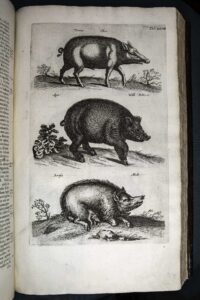
The work presents a comprehensive survey of animals known to European scholars in the mid-17th century and contains around 250 finely detailed copperplate engravings across five volumes depicting birds, fish, mammals, reptiles, and insects. While ambitious in scope, the book also reflects the geographical limits of knowledge available at the time. Many animals from the Americas and other recently explored regions are absent or only sparsely represented, revealing how scientific understanding depended on the movement of books, specimens, and travellers’ accounts across Europe.
Many of the illustrations were engraved by Matthäus Merian, one of the leading German engravers and publishers of the period. Some images drew on earlier celebrated works, including Albrecht Dürer’s famous 1515 woodcut of a rhinoceros.
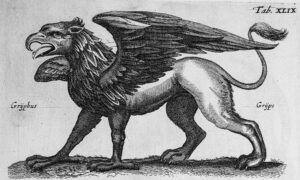
Alongside recognised animals, Jonston included legendary creatures such as unicorns, griffins, and dragons. In the 17th century, natural historians often brought together direct observation, classical authorities, and travellers’ accounts, and distinctions between documented and mythical animals were not always made in the way they are today.
Jonston’s books were translated into German, Dutch, and English and remained important reference works in zoology and natural history for many decades. Today, Historia Naturalis is valued as a remarkable example of early scientific publishing and offers a fascinating insight into how scholars of the 17th century sought to understand, classify, and represent the diversity of life.
Photography by David Sumner.