Our Book of the Month for May, part of Books Unchained — our monthly series exploring the remarkable volumes preserved in Wells Cathedral’s historic Chained Library.
Visit the Blog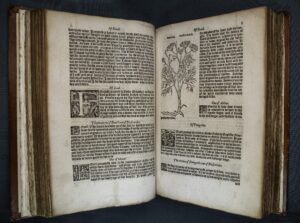
The Newe Herball
Dean Dr. William Turner
Cologne, 1568
William Turner (1508–1568) was educated and ordained at Cambridge University during a period of major religious change in England. A committed Protestant, he also developed a strong interest in plants and medicine while at Cambridge University. In 1538 he wrote Libellus de Re Herbaria in Latin in 1538, marking the beginning of his lifelong contribution to botany.
Turner later travelled widely in Europe and qualified as a doctor of medicine in Italy. On his return to England he became chaplain and physician to the Duke of Somerset, Lord Protector to the young King Edward VI. Through this connection, Turner was appointed Dean of Wells Cathedral from 1551 to 1553.
When Queen Mary ascended to the throne in 1553 and restored Roman Catholicism, Turner’s Protestant beliefs forced him into exile in Europe. During these years he continued his botanical and medical studies. In 1560 Queen Elizabeth I restored him to the Deanery of Wells, though disagreements over his outspoken religious views later led to his suspension. Turner moved to London in 1564, where he died in 1568, still holding the title of Dean of Wells.
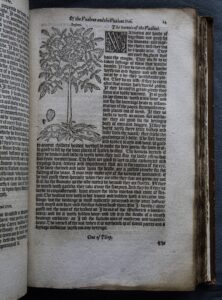
William Turner’s most celebrated work, A New Herball, was published in three parts (1551, 1562, and 1568) and later bound together in copies such as the one held at Wells Cathedral. Covering 238 native British plants alongside species from abroad, the book features detailed woodcut illustrations—many derived from Leonhart Fuchs’s 1542 work—and offers careful, firsthand observations. It marked the first comprehensive and systematic survey of English plants, establishing Turner as the “Father of English Botany.”
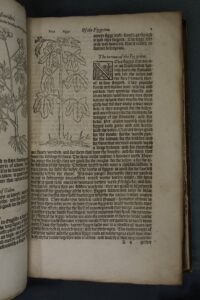
Distinct from many scholars of his time, Turner chose to write in English rather than Latin, aiming to make botanical and medical knowledge accessible to physicians, apothecaries, and herbalists across the country. Each plant entry included descriptions of its “uses and vertues,” making this the first widely available herbal in the English vernacular. Turner acknowledged that some critics might object to sharing such knowledge beyond a professional audience, but his approach ultimately broadened access to scientific learning.
His work had a lasting influence on later botanists such as John Ray and Jean Bauhin. Today, Turner’s legacy continues to be celebrated through projects like the recreation of his garden and herbal practices in the Camery Garden at Wells Cathedral, highlighting his enduring impact on both science and cultural history.
Today, William Turner is remembered as a pioneering botanist, physician, and scholar whose writings laid the foundations for the scientific study of plants in England.
Photography by David Sumner.