Our Book of the Month for August, part of Books Unchained — our monthly series exploring the remarkable volumes preserved in Wells Cathedral’s historic Chained Library.
Visit the Blog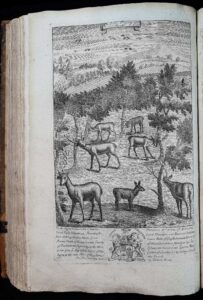
The Gentleman’s Recreation
Richard Blome
1686
Richard Blome (1635–1705) was one of the most prolific and enterprising publishers in late seventeenth-century London. Although often remembered as a colourful and controversial figure, Blome was less a scholar than a shrewd businessman. Rather than writing his own books, he specialised in bringing together information from a range of sources and publishing it in attractive, marketable volumes. He was also an early pioneer of subscription publishing, securing financial backing before a book was printed.
Not everyone admired his methods. The Oxford antiquarian Anthony à Wood described Blome as an “impudent person” who relied on “tricks” to raise money. Blome financed many of his publications by inviting wealthy patrons to subscribe in advance, often promising to include their family coats of arms alongside finely engraved illustrations. With funding secured, he employed writers and translators, frequently people in financial difficulty, to compile or adapt the text for relatively modest fees, while he oversaw the publication of the finished work.
Published in 1686, The Gentleman’s Recreation is one of Blome’s most ambitious works. Produced as a large folio volume, it was intended as a comprehensive guide for country gentlemen and for those aspiring to the lifestyle and accomplishments of the landed gentry.
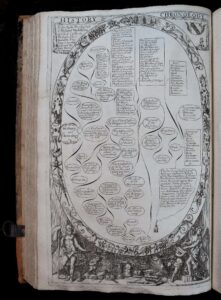
The book is divided into two substantial sections. The first explores the arts and sciences, providing an accessible overview of subjects such as philosophy, logic, mathematics, navigation, military strategy, and other fields of knowledge considered essential to a well-educated gentleman. It served as a practical reference work, enabling readers to participate confidently in the intellectual and social life of their day.
The second section turns to the practical management of the country estate and the leisure pursuits associated with rural life. It offers detailed guidance on horsemanship, hunting, hawking, fishing, fowling, agriculture, and other activities, reflecting both the responsibilities and recreations of seventeenth-century country life.
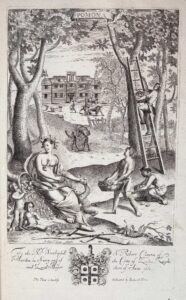
One of the book’s greatest attractions is its rich visual content. Most of the illustrations were designed by Francis Barlow, now regarded as the father of British sporting art. Although some contemporary critics considered the engravings less refined than the finest examples produced on the Continent, they are highly valued today for their remarkable documentary detail. The illustrations provide an engaging record of sporting life during the reign of King James II, depicting clothing, equipment, hunting methods, horses, and rural landscapes with exceptional clarity.
The Gentleman’s Recreation offers a fascinating insight into both the ambitions of Richard Blome and the world of the late seventeenth-century gentleman. Its combination of practical knowledge, intellectual learning, and country pursuits reflects the breadth of accomplishments expected of the period’s social elite. At the same time, its lavish illustrations—particularly those associated with Francis Barlow—give the book a lasting importance beyond its original purpose. Blome may have been a shrewd and controversial publisher, but The Gentleman’s Recreation demonstrates his ability to recognise a market and bring together material that would appeal to contemporary readers. Today, the volume remains a valuable and visually compelling record of Restoration England.
Photography by David Sumner.